
Compact Flash-lamp Pumped Q-switched Nd:YAG Lasers NL300
Compact Flash-lamp Pumped Q-switched Nd:YAG Lasers
NL300 series electro-optically Q-switched nanosecond Nd:YAG lasers produce high energy pulses with 3 – 6 ns duration at up to 20 Hz repetition rate. A wide range of harmonic generator modules for generation up to a 5th harmonic is available.

| Model | NL303HT-10 | NL303HT-20 | NL305HT-10 | NL305HT-5 |
|---|---|---|---|---|
| Main specifications 1) | ||||
| Pulse repetition rate | 10 Hz | 20 Hz | 10 Hz | 5 Hz |
| Pulse energy | ||||
| at 1064 nm | 800 mJ | 800 mJ | 1000 mJ | 1100 mJ |
| at 532 nm 2) | 400 mJ | 400 mJ | 650 mJ | 700 mJ |
| at 355 nm 3) | 250 mJ | 250 mJ | 400 mJ | 450 mJ |
| at 266 nm 4) | 80 mJ | 60 mJ | 100 mJ | 120 mJ |
| at 213 nm 5) | 13 mJ | 10 mJ | 20 mJ | 25 mJ |
| Pulse energy stability (StdDev) 6) | ||||
| at 1064 nm | 1.0 % | 1.0 % | 1.0 % | 1.0 % |
| at 532 nm | 1.5 % | 1.5 % | 1.5 % | 1.5 % |
| at 355 nm | 3.0 % | 3.0 % | 3.0 % | 3.0 % |
| at 266 nm | 3.5 % | 3.5 % | 3.5 % | 3.5 % |
| at 213 nm | 6.0 % | 6.0 % | 6.0 % | 6.0 % |
| Power drift 7) | ±2 % | ±2 % | ±2 % | ±2 % |
| Pulse duration 8) | 3 – 6 ns | 3 – 6 ns | 3 – 6 ns | 3 – 6 ns |
| Polarization | vertical, >90 % | vertical, >90 % | vertical, >90 % | vertical, >90 % |
| Optical pulse jitter (StdDev) 9) | < 0.5 ns | < 0.5 ns | < 0.5 ns | < 0.5 ns |
| Linewidth | < 1 cm‑1 | < 1 cm‑1 | < 1 cm‑1 | < 1 cm‑1 |
| Beam profile 10) | Hat-Top in near and near Gaussian in far fields | Hat-Top in near and near Gaussian in far fields | Hat-Top in near and near Gaussian in far fields | Hat-Top in near and near Gaussian in far fields |
| Typical beam diameter 11) | ~8 mm | ~8 mm | ~10 mm | ~10 mm |
| Beam divergence 12) | < 0.6 mrad | < 0.6 mrad | < 0.6 mrad | < 0.6 mrad |
| Beam pointing stability (RMS) 13) | 50 µrad | 50 µrad | 50 µrad | 50 µrad |
| Beam height | 68 mm | 68 mm | 68 mm | 68 mm |
| Physical characteristics | ||||
| Laser head size (W × L × H) 14) | 154 × 475 × 128 mm | 154 × 475 × 128 mm | 154 × 475 × 128 mm | 154 × 475 × 128 mm |
| Power supply unit (W × L × H) | 330 × 490 × 585 mm | 330 × 490 × 585 mm | 330 × 490 × 585 mm | 330 × 490 × 585 mm |
| Umbilical length | 2.5 m | 2.5 m | 2.5 m | 2.5 m |
| Operating requirements | ||||
| Water consumption (max 20 °C) 15) | < 8 l/min | < 12 l/min | < 10 l/min | < 6 l/min |
| Ambient temperature | 15 – 30 °C | 15 – 30 °C | 15 – 30 °C | 15 – 30 °C |
| Relative humidity | 20 – 80 % (non-condensing) | 20 – 80 % (non-condensing) | 20 – 80 % (non-condensing) | 20 – 80 % (non-condensing) |
| Power requirements | 208 – 240 V AC, single phase, 50/60 Hz | 208 – 240 V AC, single phase, 50/60 Hz | 208 – 240 V AC, single phase, 50/60 Hz | 208 – 240 V AC, single phase, 50/60 Hz |
| Power consumption | < 1.5 kVA | < 2.5 kVA | < 2.5 kVA | < 1.5 kVA |
| Cleanliness of the room | not worse than ISO Class 9 | not worse than ISO Class 9 | not worse than ISO Class 9 | not worse than ISO Class 9 |
| Model | NL303HT-10 | NL303HT-20 | NL305HT-10 | NL305HT-5 |
|---|
- Due to continuous improvement, all specifications are subject to change without notice. The parameters marked typical are not specifications. They are indications of typical performance and will vary with each unit we manufacture. Unless stated otherwise all specifications are measured at 1064 nm and for basic system without options.
- With H300SH, H300S or H300SHC harmonic generator modules. See Harmonic Generators Selection Guide for more detailed information.
- With H300THC harmonic generator modules. See Harmonic Generators Selection Guide for more detailed information.
- With H300SH and H400FHC harmonic generator modules. See Harmonic Generators Selection Guide for more detailed information.
- With H300FiHC harmonic generator module. See Harmonic Generators Selection Guide for more detailed information.
- Averaged from pulses, emitted during 30 sec time interval.
- Measured over 8 hours period after 20 min warm-up when ambient temperature variation is less than ± 2 °C and humidity <± 5%.
- FWHM.
- With respect to SYNC OUT pulse.
- Near field (at the output aperture) TOP HAT fit is >70%.
- Beam diameter is measured at 1064 nm at the 1/e2 level.
- Full angle measured at the 1/e2 level.
- Beam pointing stability is evaluated as movement of the beam centroid in the focal plane of a focusing element.
- See Harmonic Generators Selection Guide for harmonic generators units sizes.
- For water cooled version. Air cooled version does not require tap water for cooling.
- Power requirements should be specified when ordering.
- 110 V AC powering is available, please inquiry for details.
- Required current rating can be calculated by dividing power value by mains voltage value.
Note: Laser must be connected to the mains electricity all the time. If there will be no mains electricity for longer that 1 hour then laser (system) needs warm up for a few hours before switching on.

Ordering information of NL300 series lasers.
Selection guide
| Module | Description | Output ports | Output pulse energy specifications | Dimensions W×L×H, mm | Extension possible? | Notes |
|---|---|---|---|---|---|---|
| H300A | Attenuator for 1064 nm beam | Port 1: 1064 nm beam | Transmission in 5 – 90% range at 1064 nm | No | Integrated into a laser head | |
| H300SH | Second harmonic generator | Port 1: 1064, 532 nm | n/d | 154×160×128 | Yes | |
| H300S | 532 nm beam separator | Port 1: 532 nm Port 2: residual 1064 nm | See NL300 specifications for 532 nm beam | 154×160×128 | No | Should be used with H300SH |
| H300SHC | Second harmonic generator with 532 nm beam separator | Port 1: 532 nm Port 2: residual 1064 nm | See NL300 specifications for 532 nm beam | 154×210×128 | No | |
| H300SHA | Second harmonic generator, beam separator and attenuator for 532 nm beam | Port 1: 532 nm Port 2: residual 532 nm | Transmission in 5 – 90% range at 532 nm | 154×260×128 | No | |
| H300THC | Third harmonic generator with 355 nm beam separator | Port 1: 355 nm Port 2: residual 1064 & 532 nm | See NL300 specifications for 355 nm beam | 154×210×128 | No | Should be used with H300SH |
| H300THA | Third harmonic generator, beam separator and attenuator for 355 nm beam | Port 1: 355 nm Port 2: residual 355 nm | Transmission in 5 – 90% range at 355 nm | 154×260×128 | No | Should be used with H300SH |
| H300FHC | Fourth harmonic generator with 266 nm beam separator | Port 1: 266 nm Port 2: residual 532 nm | See NL300 specifications for 266 nm beam | 154×260×128 | No | Should be used with H300SH |
| H300FHA | Fourth harmonic generator, beam separator and attenuator for 266 nm beam | Port 1: 266 nm Port 2: residual 266 nm | Transmission in 5 – 75% range at 266 nm | 154×430×128 | No | Should be used with H300SH |
| H300FiHC | Fifth harmonics generator with 213 nm beam separator | Port 1: 213 nm Port 2: residual 1064, 532 & 266 nm | See NL300 specifications for 213 nm beam | 154×350×128 | No |
| Module | Description | Output ports | Output pulse energy specifications | Dimensions W×L×H, mm | Extension possible? | Notes |
|---|
Features
- Compact harmonic modules
- Thermo stabilized crystals for long lifetime
- Dichroic mirrors
- AR coatings on crystals
- Phase matching by mechanical adjustment
- High conversion efficiency
- Wide selection of different configurations
- Smooth adjustment of output pulse energy with attenuator
Nanosecond Q-switched lasers enable simple and cost effective laser wavelength conversion to shorter wavelengths through harmonic generation. EKSPLA offers a broad selection of wavelength conversion accessories for NL300 series lasers. The purpose of this guide is to help configure available harmonic generator and attenuator modules for NL300 series lasers for optimal performance.
The harmonic module uses a modular design that allows reconfiguration of laser output for the appropriate experiment wavelength. A typical module houses a non‑linear crystal together with a set of dichroic mirrors for separating the harmonic beam from the fundamental wavelength. Nonlinear crystals used for the purpose of wavelength conversion are kept at an elevated temperature in a thermo-stabilized oven.
Two or more modules can be joined together for higher harmonic generation: attaching one extra module to a second harmonic generator allows for the generation of 3rd or 4th harmonic wavelengths. It should be noted that only modules with a single output port can be joined together: it is possible to attach a H300S module to a H300SH unit for 532 nm beam separation, or a H300FHC module for 4th harmonic generation (see detailed description below). Modules with two output ports (e.g., H300SHC) cannot be attached to extra units.
H300A attenuator
The H300A1 module is integrated into the laser head and designed to attenuate a 1064 nm.
Beam (the length of the laser head extends to 619 mm). Optical layout includes half-wave plates HWP1, HWP2 and polarizers P1, P2. Rotation of the HWP2 half-wave plate changes the polarization of the laser beam and its transmission factor via the P2 polarizer.
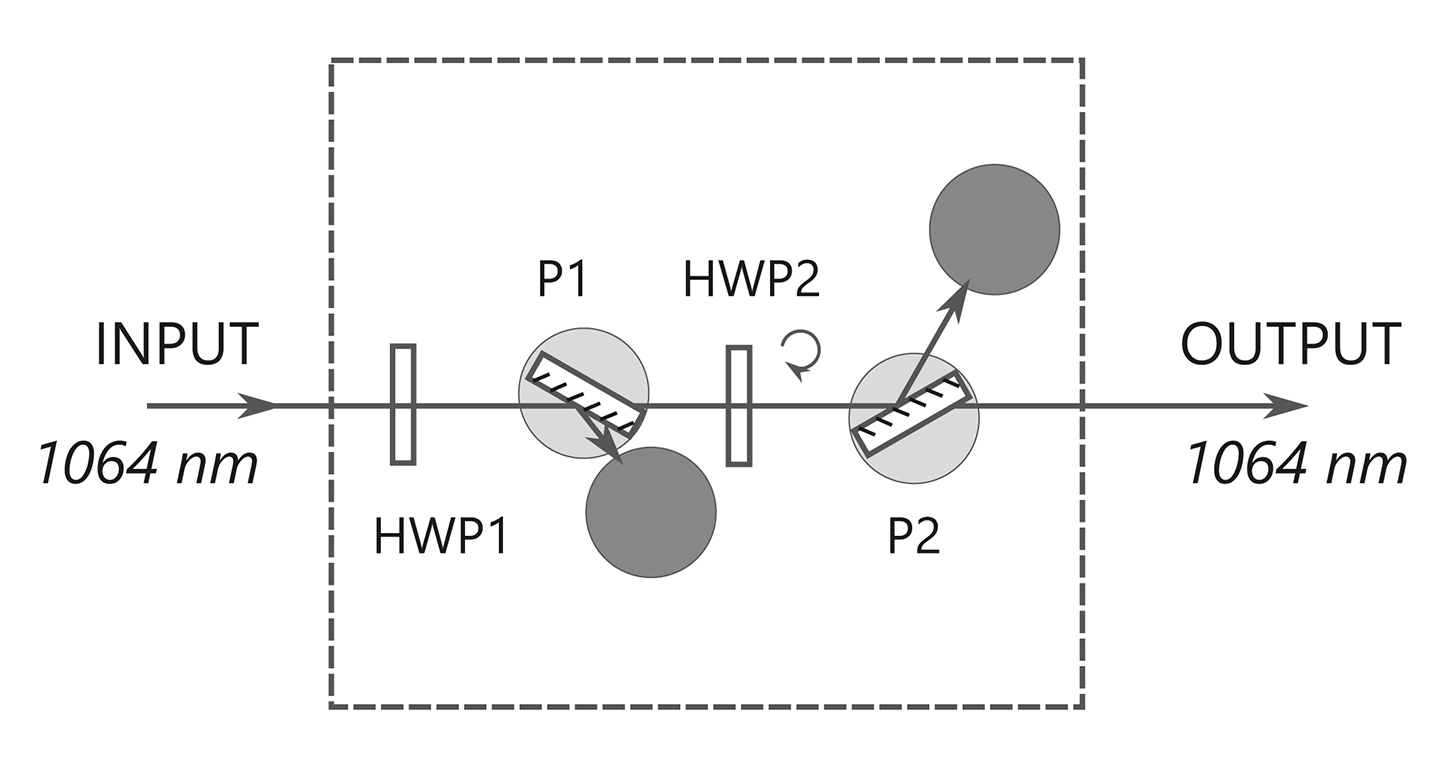
Optical layout of H300A attenuator.
H300SH harmonic generator
H300SH module contains a SH crystal with a half-wave plate for input polarization adjustment. The output of the H300SH module has both 532 nm and 1064 nm wavelengths.

Optical layout of H300SH harmonic generator.
H300S harmonic separator
The H300S module has two output ports for the separation of 1064 nm and 532 nm wavelengths.

Optical layout of H300S harmonic separator.
H300SHC harmonic generator
The most cost-effective solution for customers who need a 532 nm wavelength only, the H300 SHC module combines a SHG crystal and beam separators and has two output ports for 532 nm and 1064 nm beams.
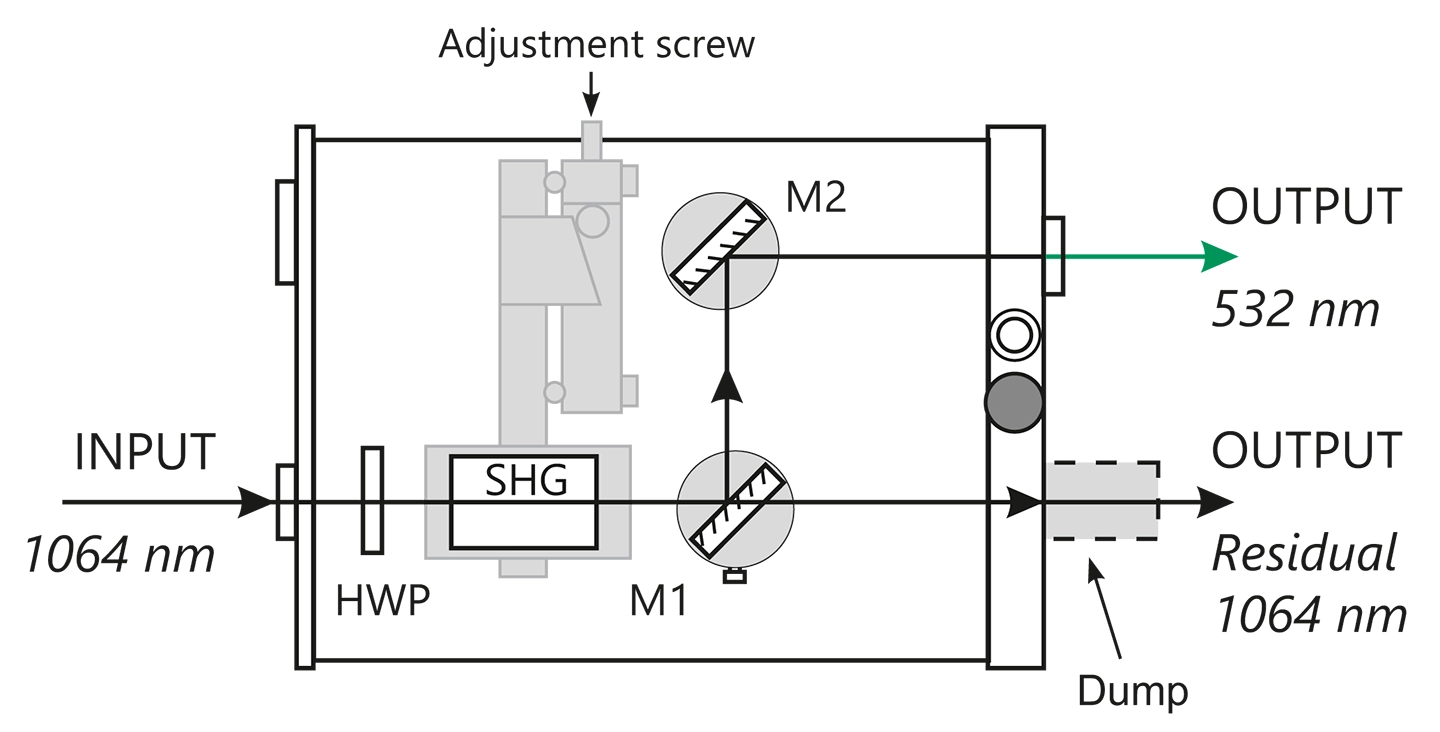
Optical layout of H300SHC harmonic generator.
H300THC harmonic generator
The H300THC module is a third harmonic generator and beam separator with two output ports for a 355 nm beam, and for a residual 532 nm + 1064 nm beam. This module should be used with the H300SH module.
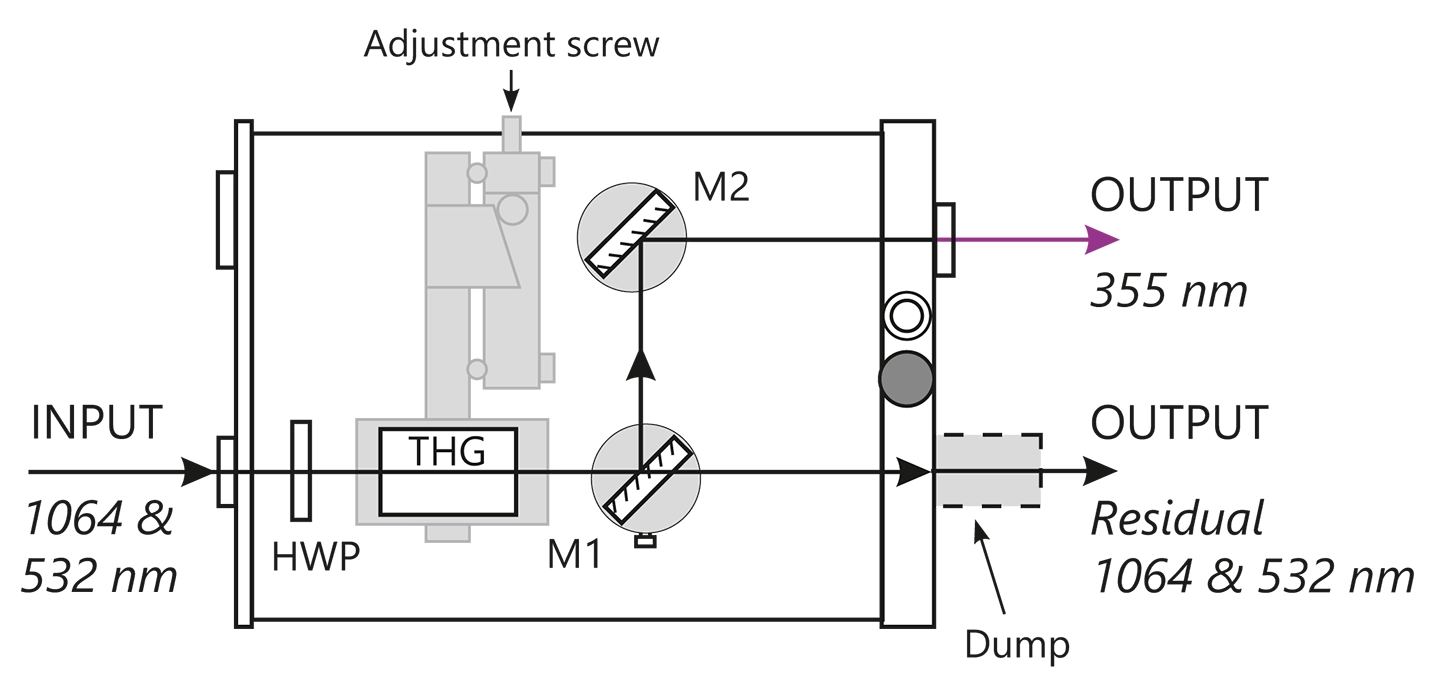
Optical layout of H300THC harmonic generator.
H300SHA harmonic generator & attenuator
The cost-effective solution for customers who need an attenuated 532 nm wavelength, the H300SHA module combines a SHG generator with attenuator.
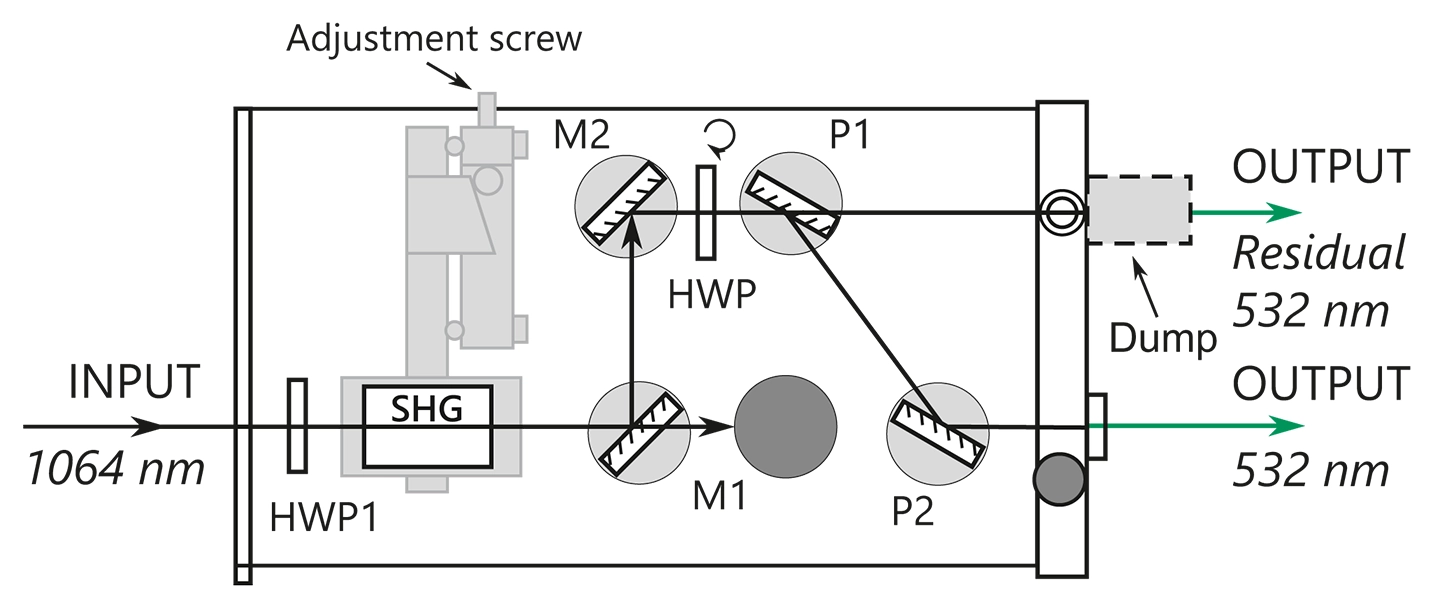
Optical layout of H300SHA harmonic generator & attenuator.
H300THA harmonic generator & attenuator
The cost-effective solution for customers who need an attenuated 355 nm wavelength, the H300THA module combines a THG generator with attenuator.
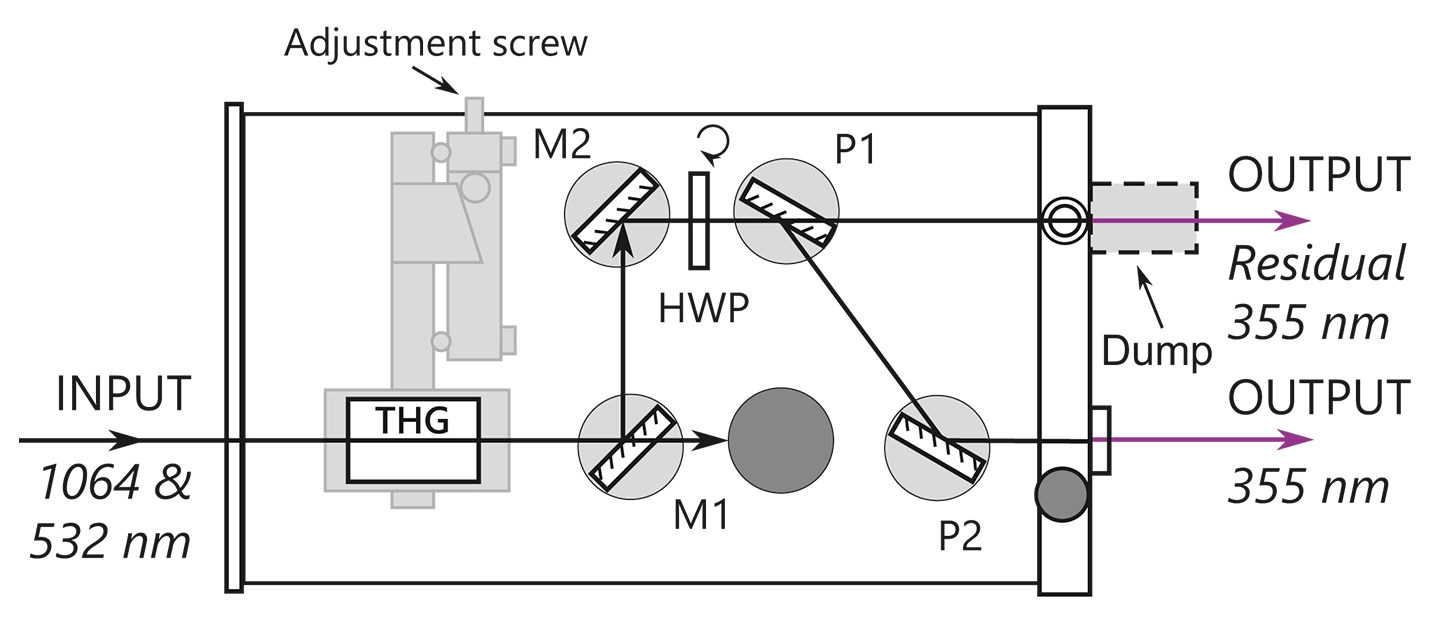
Optical layout of H300THA harmonic generator & attenuator.
H300FHC harmonic generator
The H300FHC module is a fourth harmonic generator and beam separator for a 266 nm wavelength, with two output ports for a 266 nm beam, and for a residual 532 nm beam. This module should be used with the H300SH module.

Optical layout of H300FHC harmonic generator.
H300FiHC harmonic generator
The H300FiHC module is designed to produce a 5th harmonic output. As it requires only a 1064 nm input, the unit contains SH, FH and FiH crystals together with a beam separator for a 213 nm beam.
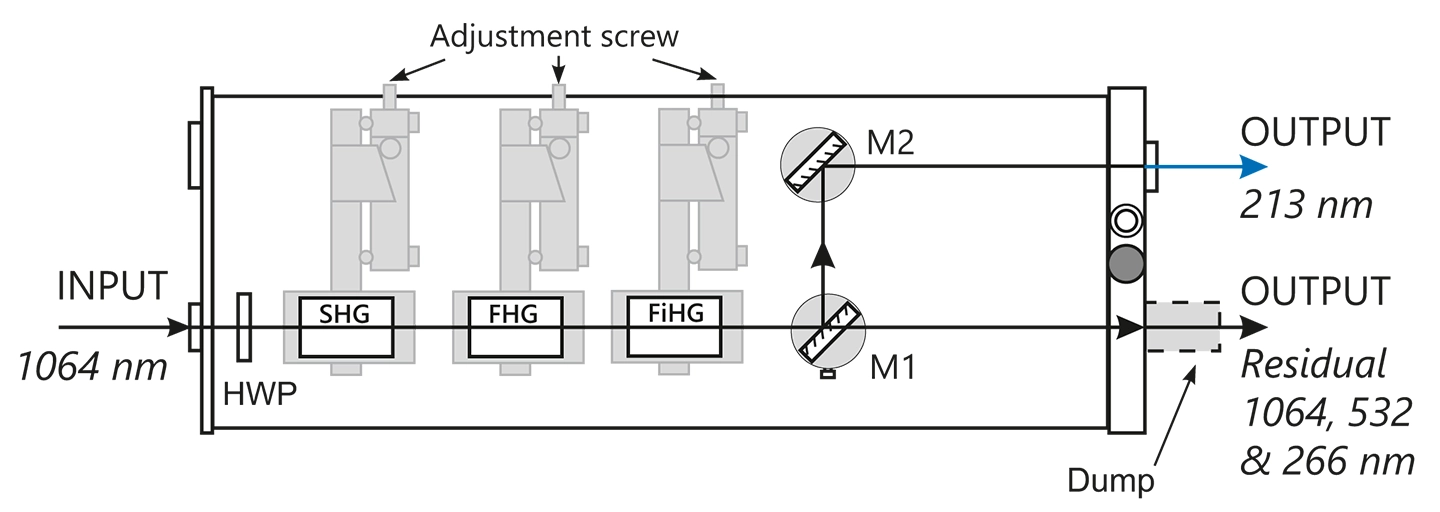
Optical layout of H300FiHC harmonic generator.
H300FHA harmonic generator & attenuator
The cost-effective solution for customers who need an attenuated 266 nm wavelength, the H300FHA module combines a FHG generator with attenuator.
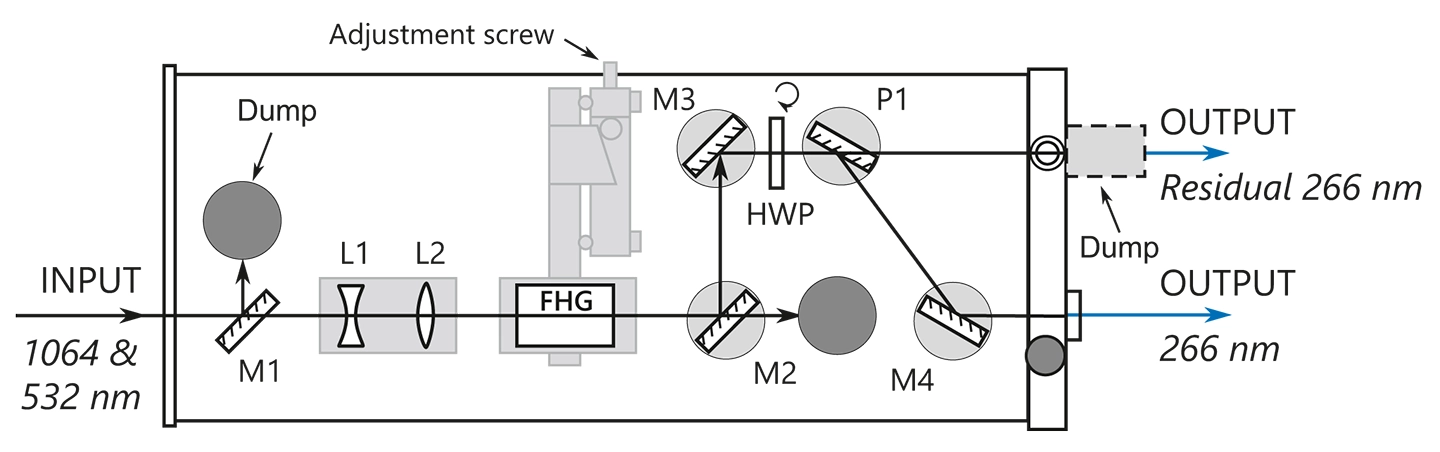
Optical layout of H300FHA harmonic generator & attenuator.

Typical NL300 series laser head outline drawing.
